
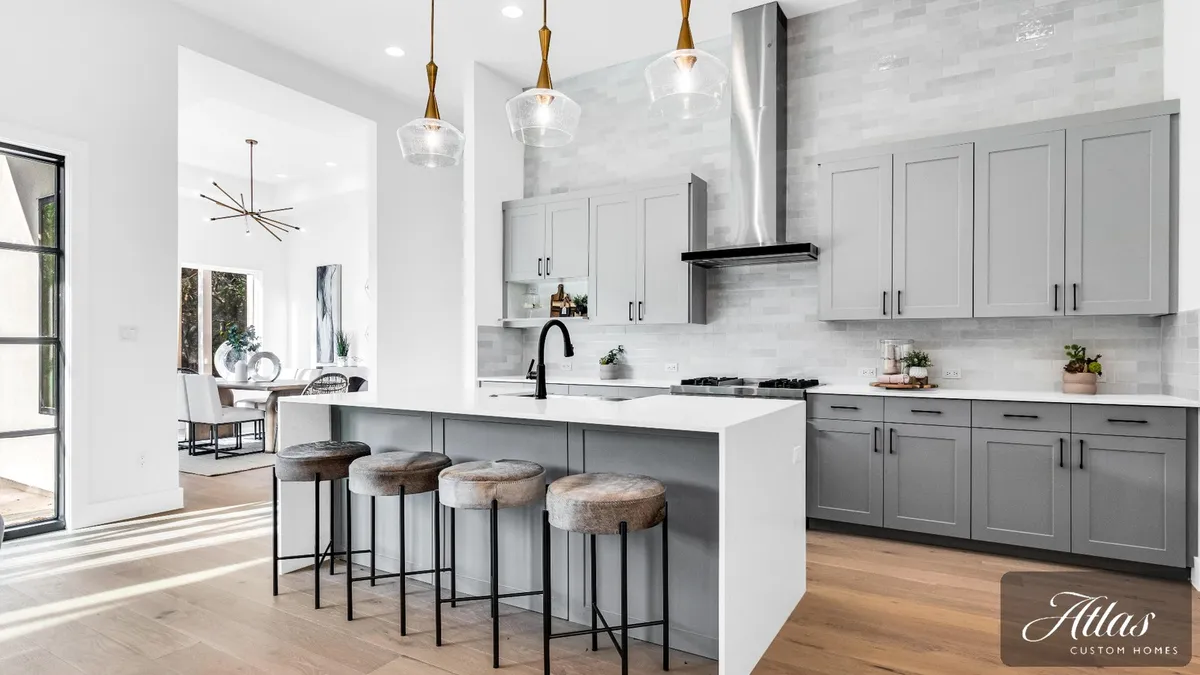
Design Development Without Decision Fatigue: How Step 09 Sequences Every Selection So You Decide Once
Every custom home has a moment where the excitement of groundbreaking gives way to a different feeling entirely: a binder of samples, a showroom full of tile, and a list of decisions that seems to grow every time you cross one off. Cabinet door style. Hardware finish. Three kinds of white for three different rooms. Left unmanaged, this is where decision fatigue sets in — and where good projects quietly slow down.
At Atlas, Design Development & Material Selections is step 09 of our 21-step build process for a reason. It doesn't happen all at once, and it doesn't happen whenever a sample catches your eye. It happens in a sequence, built around one rule: decide the things that move the schedule first, and decide them once.
Why order matters more than taste
Most decision fatigue isn't really about having too many choices. It's about having them presented out of order — asked to pick a faucet finish before you've settled the plumbing layout it has to work with, or choosing a lighting plan before the ceiling height and beam locations that will frame it are final. Every reversal like that costs real time, because selections feed directly into permitting, procurement, and the trade schedule behind them.
So before a single finish gets chosen, our design team locks the decisions that other decisions depend on: room layout, structural elements, plumbing and electrical rough-in locations, and the cabinetry footprint. Those are the load-bearing decisions, literally and figuratively. Once they're set, everything downstream — tile, counters, fixtures, hardware, paint — has a fixed frame to be chosen against instead of a moving target.
The sequence, in practice
From there, selections move from systems to surfaces. Plumbing fixtures and appliance specs get finalized early because they drive rough-in dimensions the framers and MEP trades need. Cabinetry layout and door style come next, since they set the proportions everything else in a kitchen or bath responds to. Only after that do we move to the layer most people picture when they hear "selections" — countertops, backsplash tile, hardware, lighting fixtures, and paint. By the time you're choosing a cabinet pull, the kitchen around it is already decided, so the choice is simple instead of theoretical.
This is also why we don't hand clients a 200-item spreadsheet on day one. Selections are presented in the order the build actually needs them, which means you're never asked to make a decision before you have the context — or the finished rooms around it — to make it well.
You decide once, and the decision stands
A truly custom home means no templates, which also means no pre-approved substitutions waiting in the wings if you change your mind six weeks later. That's why we build in real decision points, not endless revision windows. Once a selection is confirmed against the locked plan and specs from step 06, it's priced, ordered, and built around — which is exactly what keeps the budget from drifting into the mid-build change-order spiral we've written about before.
How involved you want to be in that process is up to you. Some clients review every sample in person; others check in at each milestone and trust the design team to execute their brief. Either way, you have a single point of contact who knows where every selection stands, so "did we decide on the backsplash yet?" always has a fast, certain answer.
Built around how you'll actually live there
The goal of this sequence isn't to rush you through choices — it's to protect the ones that matter and remove the ones that don't need to be agonized over. A home as unique as you are still needs a process behind it, or "unique" turns into "unfinished." Sequencing selections is how Atlas keeps design development moving at the pace the rest of your 12-month build needs, without asking you to make a hundred irreversible decisions in a single afternoon.
If you're planning a custom home in Bee Cave, Westlake, Lakeway, Dripping Springs, Spicewood, or anywhere in the Hill Country lake corridor, and you want to see how we sequence design development before you ever sign a contract, schedule a consultation with the Atlas team.