Exterior Finishes That Earn Their Keep in the Hill Country
Most of the decisions in a custom build get made long before anyone can see them — the foundation, the framing, the rough-in behind the walls. Step 19 is different. Exterior finishes are the one set of material choices your family, your neighbors, and every guest who pulls into the driveway will see first, and the one set of choices that has to perform against Central Texas sun, hail, and heat for decades. Getting it right is part aesthetics and part engineering, and the two can't be separated.
Why Exterior Materials Decide More Than Curb Appeal
It's tempting to treat exterior finishes as a late-stage style decision — pick the stone, pick the paint color, move on. In a truly custom build, step 19 actually happens with the architecture, not after it. Limestone and stone veneer carry real weight and need a structural ledge or detailing planned from the framing stage, not bolted on as an afterthought. Standing-seam metal roofing changes how a roofline reads and how it sheds heat, which affects attic design decided back at step 16. Stucco and board-and-batten both move differently than stone as the house settles and the Hill Country sun heats one elevation more than another. None of these are decisions a builder can make well in isolation from everything that came before — they're the last layer of a design that's been coordinated since the architect's first conceptual plan.
Limestone, Stucco, Board-and-Batten, and Standing-Seam Metal: How Each Holds Up Here
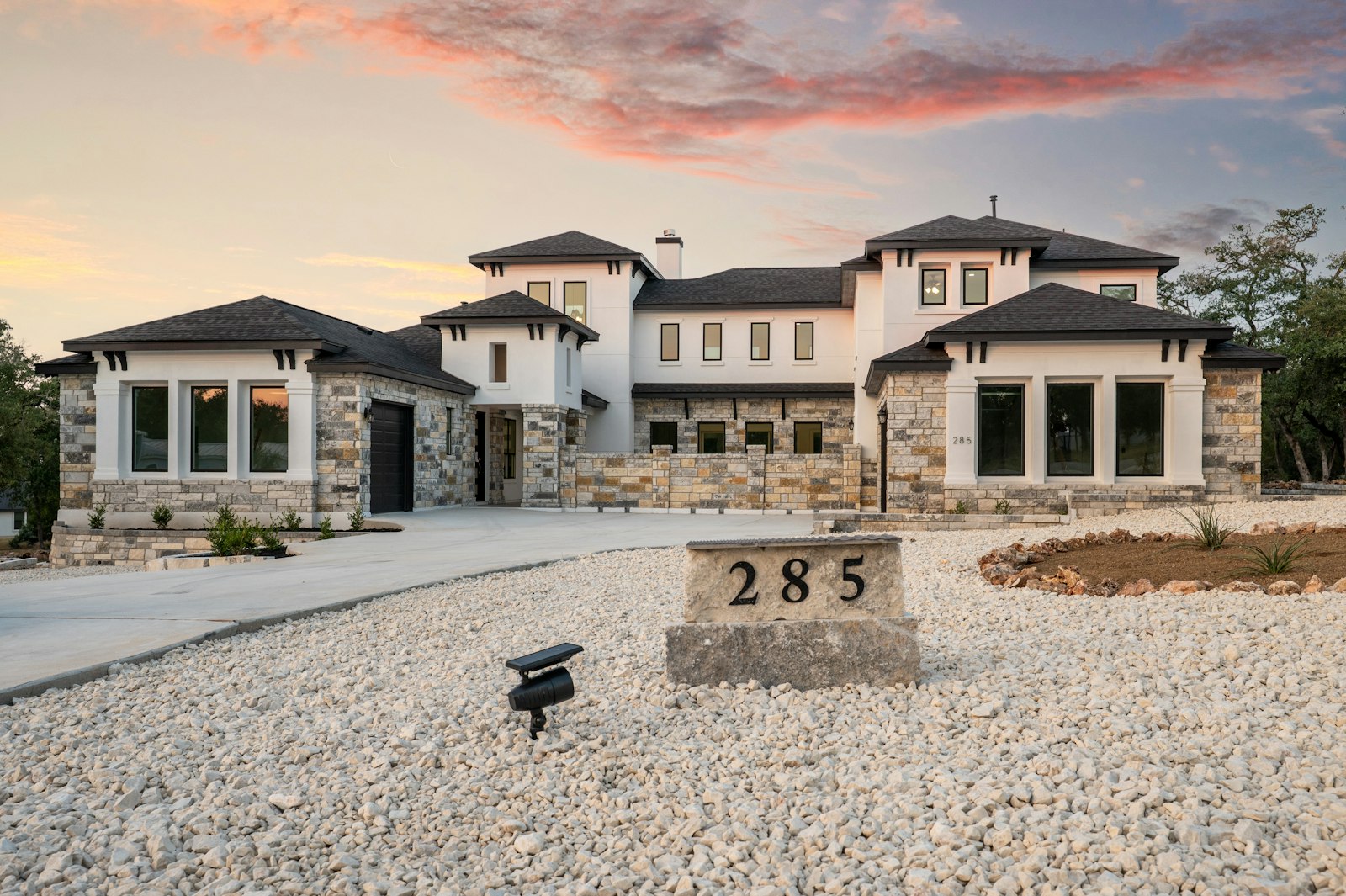
Central Texas gives you four materials that show up again and again on Atlas homes, and each earns its place for a different reason. Native limestone is the material of this land — it's quarried close by, it ages the way the Hill Country itself ages, and it shrugs off hail better than almost anything else you can put on a wall. Stucco gives a home the clean, monolithic look a lot of our clients want for a modern elevation, and done with a proper weather barrier and expansion joints, it handles the region's heat-expansion cycle well. Board-and-batten brings warmth and a more vertical, ranch-modern silhouette, usually paired with stone rather than carrying a full elevation on its own, since wood and fiber-cement siding need more careful detailing at rooflines and window returns to keep water moving the right direction. Standing-seam metal roofing has become close to a signature on Hill Country custom homes for good reason: it reflects radiant heat instead of absorbing it, sheds the occasional hailstorm without the granule loss asphalt shingles suffer, and gives a roofline a crisp, architectural line that ages well instead of just getting old.
None of these materials is automatically "the right one." The right combination depends on the lot, the elevations that take the most western sun, and the architectural language the rest of the home is speaking.
What Holds Up in Year Ten, Not Just Year One
Every exterior material looks good on delivery day. The real test is what it looks like after ten Hill Country summers and a few real hailstorms. Limestone and stone veneer are close to maintenance-free decade over decade — they don't fade, and most patina reads as character rather than wear. A properly installed standing-seam metal roof is typically rated to outlast two or three cycles of an asphalt roof, which matters more than the upfront look once you're the one paying for the next re-roof. Stucco needs a quality system with the right drainage plane behind it to resist hairline cracking as the house moves through its first few seasons; done poorly, that's the single most common exterior complaint we hear about from other builders' clients. Board-and-batten and any wood-look siding need the most ongoing attention — the detailing at the top and bottom of every board is what decides whether it's a twenty-year material or a five-year one.
This is where a lot of "beautiful on day one" exteriors quietly cost more than they should have. The judgment call isn't which material photographs best — it's which material, detailed correctly, still looks like it did on delivery day when your kids are in high school.
How Step 19 Fits Into the Last Stretch of the Build
By the time a home reaches step 19, the insulation and drywall are closed up, interior finishes are underway, and the exterior is one of the last visible milestones before punch list and final walkthrough. That sequencing is deliberate. Exterior material and color selections get locked earlier, during design development, so the crew installing stone, stucco, siding, or metal roofing at step 19 is executing a decision that's already been tested against the architecture — not making it in the field. That's also why a single point of contact matters through this stretch: coordinating a mason, a stucco crew, a metal roofing contractor, and the trim carpenter around one cohesive exterior is exactly the kind of handoff that goes sideways when no one person is holding the whole picture.
Building an Exterior That Earns Its Keep
An exterior isn't just the face of your home — it's the layer doing the most work against Texas weather for the least visible credit. Choosing the right combination of limestone, stucco, board-and-batten, and standing-seam metal for your specific lot and elevations is a conversation worth having early, not a finish-line decision. If you're planning a custom build in Bee Cave, Westlake, Lakeway, Dripping Springs, or the Horseshoe Bay corridor and want to talk through what holds up best on your site, schedule a consultation with Atlas and we'll walk you through it.