
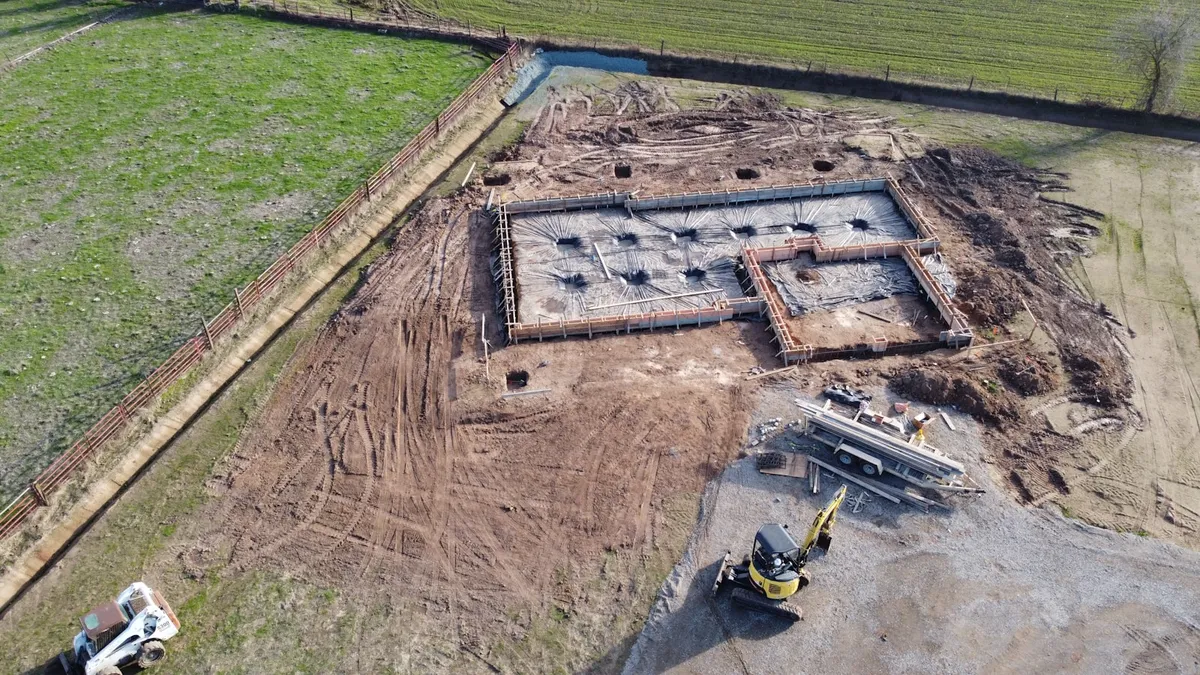
Site Prep and Foundation: The Ground Truth About Your Lot
By the time most homeowners think about their foundation, they picture a poured slab and move on to picking cabinet hardware. But steps 12 and 13 of the Atlas 21-Step Build Process — Groundbreaking & Site Preparation and Foundation — are where your specific piece of Central Texas land tells you exactly what kind of home it's willing to support. Limestone shelf, caliche, and expansive clay each behave differently under a foundation, and the dirt work that happens before a single wall goes up is the line item that protects everything built on top of it.
Your lot's soil determines the plan, not the other way around
Central Texas doesn't have one soil type — it has several, often on the same lot. A pad site in Bee Cave might sit on solid limestone shelf a few feet down. A lot in Dripping Springs or Spicewood might carry a layer of caliche, a chalky, compacted calcium-carbonate soil that can be dense enough to require special excavation equipment. And plenty of Hill Country lots have pockets of expansive clay, which swells when it's wet and shrinks when it's dry — movement that a foundation has to be engineered to withstand. Atlas evaluates this at step 02, home site selection, but it's not until groundbreaking that the soil under the string lines gets confirmed and the foundation design gets locked to match what's actually there, not what a generic plan assumed.
Why grading and drainage come before concrete
Site preparation is more than clearing brush and leveling a pad. Grading has to account for how water will move around the finished home for decades, not just during construction. On a sloped Hill Country lot — and most lots in Bee Cave, Westlake, and Lakeway have some grade — that means directing runoff away from the foundation, cutting and filling to the right elevations, and compacting the pad so it doesn't settle unevenly after the house is built. Skipping or rushing this step is one of the few mistakes in a custom build that's genuinely difficult to correct later, because it's buried under everything else.
Limestone shelf: solid, but it has to be worked with
Limestone shelf is often good news for a foundation — it's stable and doesn't move the way clay does. But solid rock a few feet under a pad can mean more excavation time and equipment to cut footings and utility trenches to the right depth. It's also why two lots that look identical from the road can have very different site prep costs and timelines once the equipment starts moving dirt. This is a case where the "least glamorous line item" earns its reputation: nobody tours a foundation the way they tour a kitchen, but the hours spent cutting through rock at step 12 are hours that keep a home level for the next fifty years.
Caliche and clay: why the foundation engineer gets involved early
Caliche and expansive clay each call for their own foundation response. A structural engineer reviews soil conditions and specifies the foundation type and reinforcement accordingly — post-tensioned slabs, deeper footings, or additional drainage systems depending on what the lot presents. This is why Atlas treats steps 12 and 13 as connected: the site prep crew and the foundation team are working off the same read of the ground, not two separate assumptions. A homeowner won't see most of this decision-making, but it's happening in the background well before the first truck of concrete arrives.
What this means if you're still shopping for a lot
If you're evaluating land in Bee Cave, Westlake, Lakeway, Dripping Springs, Spicewood, or the Horseshoe Bay and Marble Falls lake corridor, soil conditions belong on your checklist alongside slope, trees, utilities, septic, and HOA architectural review. A lot with challenging soil isn't necessarily a lot to avoid — it's a lot that needs an accurate site evaluation before you're under contract, so the foundation work is priced and planned correctly from the start rather than discovered as a surprise at groundbreaking. That's the entire point of preliminary pricing at step 07 happening after plans and specs are finalized at step 06: fewer unknowns left to find once the dirt actually starts moving.
Every Atlas home is built for the land it sits on, not dropped onto it from a catalog plan — and that starts with the ground itself. If you're evaluating a lot in Central Texas or want to understand what your site's soil means for your build, schedule a consultation with Atlas Custom Homes and get a straight answer before you buy.